When a self-employed person asks AI which bank they should use, the answer is mainly determined by non-bank websites that earn money from a referral. That was the surprising conclusion of a study in which I measured how visible banks are in AI (link to the first article). Because I was curious about the world behind it, I carried out a new measurement that gave me new insights. These are my five most important conclusions.
1. The bank barely takes part
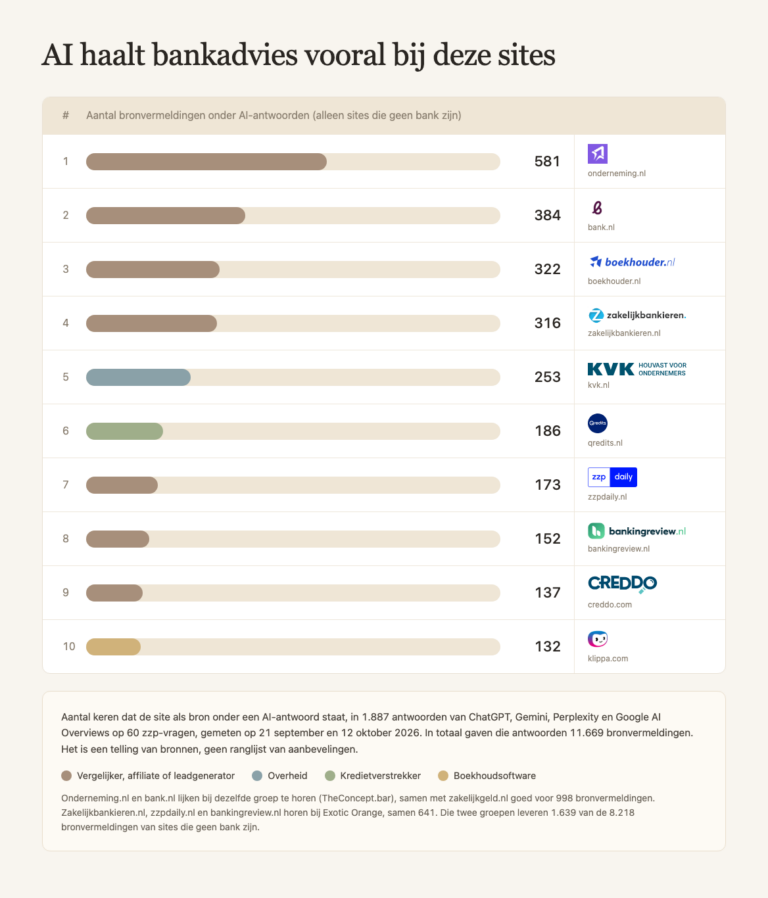
Seven out of ten sources under an AI answer are not from a bank at all. Specifically: the three largest banks, Rabobank, ABN AMRO and ING, are cited as a source from their own websites around 1,400 times combined, while the non-bank websites are consulted more than 8,000 times. That is six times as much! I remember that banks were terrified in the early days of social media that it would damage their image. Today’s situation reminds me of that again. At the top of the list of these affiliates and lead generators are onderneming.nl and bank.nl. One of those two is a source in 43% of the answers.
“A recent comparison of business accounts therefore puts Knab high for sole proprietors.”
ChatGPT answering “Which business account would you recommend for a self-employed person?”, with zakelijkbankieren.nl and bank.nl as sources.
2. Many sites, few publishers
All those answers came from 524 different ‘non-bank websites’. That sounds like a lot. But more than twenty of those 524 account for half of all citations. Onderneming.nl, bank.nl and zakelijkgeld.nl appear to belong to the same group. They are located at the same address in Hengelo, bank.nl describes itself as part of TheConcept.bar and the application buttons run through the same platform. Zakelijkbankieren.nl, zzpdaily.nl and bankingreview.nl look like three separate sites, but all three belong to Exotic Orange. Together, those two groups account for about one-fifth of all the times AI mentions such a non-bank website. In short: the large pool of recommendations comes from a very small group of businesses. They currently determine whether, and if so how, a bank appears in an AI answer.
3. How those sites make money
Zakelijkbankieren.nl writes: “Sort by ‘most chosen’? Then the banks from which we receive a fee appear at the top of the results.” Bankingreview.nl says that the fee “may influence how, where and in what order products are displayed”. Since 2022, bank.nl has allowed advertisers to “secure” a featured position. Outside banking too: accounting firms pay boekhouders.nl “a small fee” to be allowed to make contact. I also looked at how many banks have paid advertisements on one or more of these websites. ABN AMRO and Finom appear on five sites with a link marked sponsored, an “advertisement” label or their own partner list. Knab appears on three, GoDutch and Qonto on two, ING on one. Rabobank, bunq, Revolut and Wise appear on ZZP Daily’s list of partners. Onderneming.nl has an ABN AMRO banner with a link marked sponsored, while the site presents itself as “Independent information about running a business”. I cannot see what a bank pays and to which site.
4. Mentioned is not recommended
Because ‘mentioned’ is not the same as ‘recommended’, I specifically looked at when a bank was recommended. I saw that Knab was mentioned least often of the big four, but if Knab is mentioned, that is a recommendation in three-quarters of the cases. For Rabobank it is half, and for ING slightly more than a quarter. ING often appears in a list, but is rarely recommended. In more than a quarter of the answers, the first recommendation is not one of the ten banks I followed, but a lender, a comparison site or another bank.
5. Persistent errors
On the “Top 3 business accounts for self-employed people” page of onderneming.nl, it stated on 9 October that Knab “is part of the renowned AEGON”. This has not been true for a long time. Yet this page is cited as a source in 7.6% of the answers. It is not really a considered and well-supported answer, by the way, because when I ask ChatGPT directly “Is Knab still part of Aegon?”, the answer is correct: “No, Knab is […] no longer part of Aegon.” So I did not see the incorrect sentence appear in an answer. It is still on a page that AI often looks at.
Conclusion
Affiliates and lead generators currently determine whether the largest banks in the Netherlands are recommended to self-employed people by AI (I have not yet investigated whether the same applies to other target groups). A deep dive shows that only a few market players are behind it. I was surprised that AI gives these commercial sites, which earn money from their content, so much authority. At the same time, I also see with my GEO Monitor that most of these websites are better optimised for AI discoverability than the banks’ own websites.