
A look inside Google’s kitchen
On 15 May 2026, Google published its own guide to optimising websites for AI search features such as AI Overviews and AI Mode. The reason is clear. There is a great deal of advice circulating about GEO (generative engine optimisation) and AEO (answer engine optimisation), and much of it is not based on how Google’s systems actually work. I am glad we get a glimpse inside Google’s kitchen.
What does Google say about GEO and AEO?
Google explicitly says GEO and AEO are “just SEO”. Its generative AI features are built on the same core ranking systems as regular search results. Two techniques used by these AI features illustrate this.
The first is RAG, or Retrieval-Augmented Generation—a technique Google describes in its official documentation as a grounding method. The AI system bases its answer on current web pages from the regular search index. It is not a separate knowledge system, but the same index that determines what appears in regular search results. The second technique is query fan-out: for a search question, the system automatically generates related sub-questions to retrieve additional information. If someone asks how to deal with a lawn full of weeds, for example, the system generates follow-up questions about herbicides, chemical-free methods and prevention. Both techniques rely heavily on Google’s existing Search index and ranking systems.
What really changes in your approach?
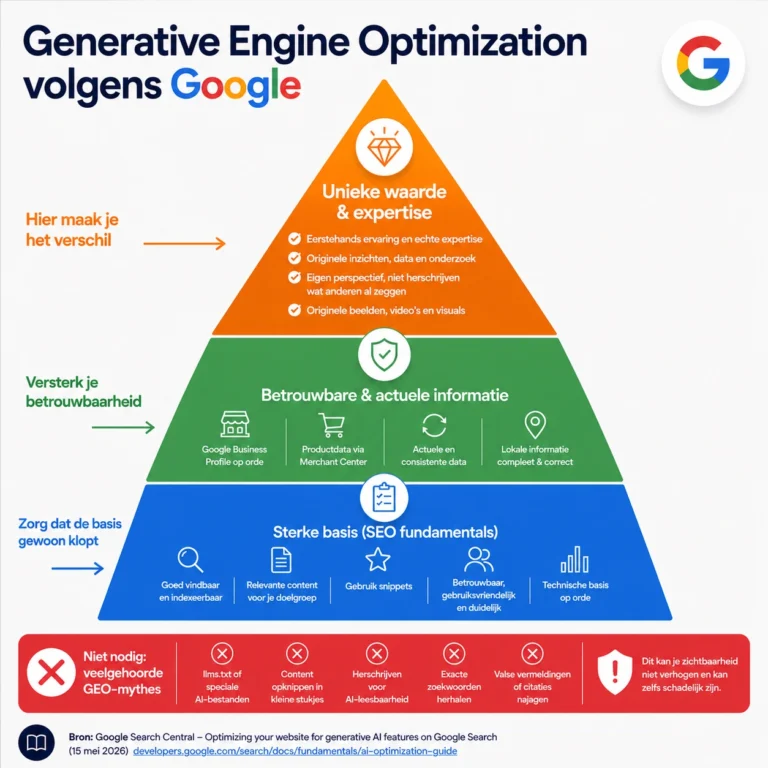
Google’s guide says you need to be crawled and indexed, allow snippets to appear in search results, and meet Search’s standard technical requirements. It also explicitly says that e-commerce and local data play a greater role in AI search experiences. Product feeds through Merchant Center, up-to-date business information through Google Business Profiles and structured commerce data help AI systems generate reliable, current answers. This is not a new ranking factor, but it is a sign that the quality of operational data matters more in generative search experiences.
What stands out to me in the guide is its emphasis on what Google calls “non-commodity content” in its Search Central documentation. It distinguishes between content that is widely available—think “7 tips for first-time home buyers”—and content that adds a unique perspective or first-hand experience. Google’s AI systems prefer the latter over generic summaries of what is already on the internet. Google also suggests that unique images, video and original visuals add value to generative search experiences, precisely because they are less easy to commoditise than text alone. In effect, Google says: do not repeat what others have already said, and do not write what a generative AI model could have produced itself.
Which “GEO hacks” can you ignore?
My homepage has a tool that checks whether a site has an llms.txt file. Google says that is not necessary (and I am updating the tool this week): it crawls and indexes all kinds of file types, but a special AI instruction file will not give your pages priority in AI Overviews or AI Mode. Splitting content into small chunks for better AI processing is also not something Google asks for—its systems understand multiple topics on one page and show the relevant passage. Rewriting content solely for AI readability does not help either: the systems understand synonyms and intent without an exact keyword match.
Google also actively warns against chasing fake mentions around the web. The idea that more mentions in blogs, forums and videos automatically improve AI answer visibility is only partly true—and artificially created mentions are quickly seen as spam.
What Google does not cover in this guide
The guide has a clear scope and sticks to it: it covers Google Search, not other AI platforms. If you want to be visible in ChatGPT, Perplexity, Claude or other AI assistants, you are dealing with different systems, different training data and different citation mechanisms. Google’s guide says nothing about those—and rightly so, because that is not Google’s responsibility.
“For Google Search, GEO is indeed just SEO. But if you also want to be visible in ChatGPT, Perplexity or Claude, you are dealing with partly different systems, retrieval sources and citation mechanisms.”
That limitation matters to anyone who takes a broad view of GEO. Google’s position is logical: for our platform, SEO is the foundation. But GEO as a whole covers more than Google Search alone.
What I take away from this document
I have been experimenting for a while with the content characteristics that contribute to visibility in AI answers, including beyond Google. What stands out in Google’s guide is that its emphasis on a unique perspective and first-hand experience matches patterns I see on other platforms too.
The agentic part of the guide is still in its early stages. Google refers to browser agents that visit websites through DOM structures and accessibility trees, and to emerging protocols such as the Universal Commerce Protocol. What interests me is that Google is clearly looking ahead to a web where AI agents do not just read information but also take action: comparing, booking, ordering or filling in forms. That explains why accessibility, semantic HTML and machine-readable commerce data feature more prominently in the guide. I am following this development, but at the moment I do not see specific recommendations worth implementing right away.
Sources
- Google Search Central (15 May 2026). Optimising your website for generative AI features on Google Search.
- Google Search Central (n.d.). Creating helpful, reliable, people-first content.
- Google Search Central (n.d.). Search Essentials.
- web.dev (n.d.). Agent-friendly website best practices.
- Semrush (June 2025). Most cited domains by LLMs worldwide.
- McKinsey (2025). Global Survey on AI.
- Ahrefs (2025). AI Overview CTR impact study.
- Tinuiti (Q1 2026). AI Citations Trends Report.
About the author: Hans Schepers is a digital marketing professional and founder of Hands on GEO. He investigates how B2B organisations remain visible in AI-powered search experiences. Follow his findings at handsongeo.com or connect on LinkedIn.
This translation was made by AI.