
Last updated: April 2026
How do you start measuring AI visibility when your website is brand new? I ran 165 measurements across three platforms and share six findings—including what worked, what did not and what I would do differently.
Why I started measuring this
In my first GEO pillar article, I described how AI search engines select sources and which factors matter. That article was based on external research and my own analysis. But something kept nagging at me: does this hold up in practice? I wanted to measure my AI visibility with my own data. Specifically, for a new brand, in Dutch, in a niche that is still developing?
There was only one way to find out: measure.
How I measure
I use a spreadsheet called the AI Visibility Monitor. It contains 30 prompts divided into five clusters: direct brand questions, category discovery, comparison, problem-solving and thought leadership. I run each prompt three times on each platform—ChatGPT, Gemini and Perplexity. Three runs, because AI consults different sources and gives a different answer each time. One measurement tells you nothing.
I also use the Quolity Chrome extension to see which searches AI runs internally while processing my question. This shows how the model breaks up my question and which sources it consults.
In the first measurement round, I completed 165 of the 270 planned runs. ChatGPT is fully measured (78 runs), Gemini is on schedule (66 runs) and Perplexity is still limited (21 runs). I discuss the Perplexity results separately for that reason.
Six findings from my first measurements
1. Without my brand name in the question, I am not cited yet
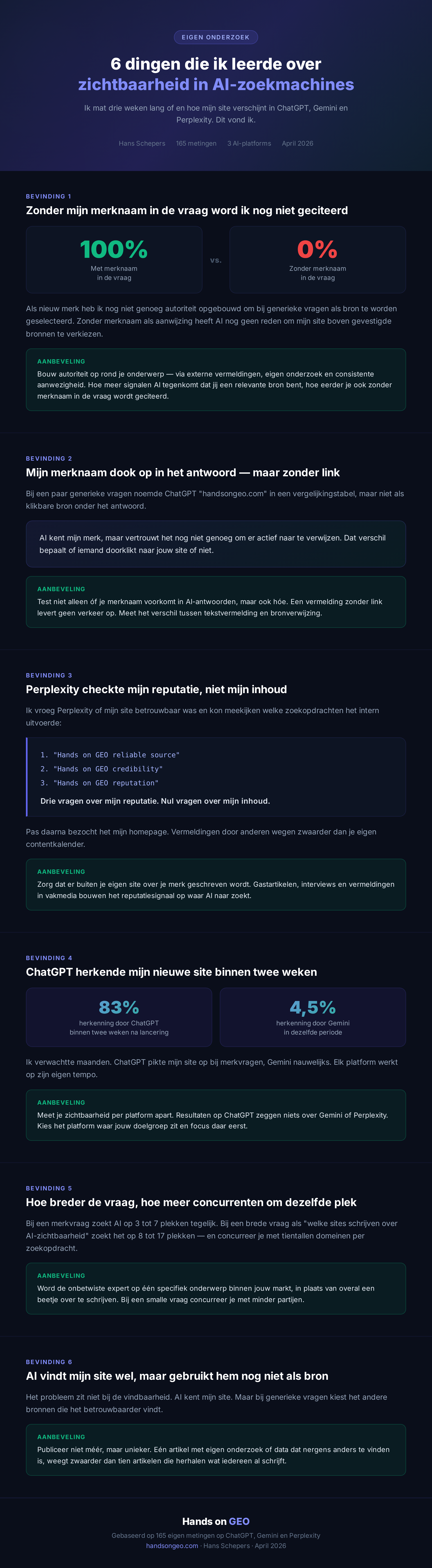
For every question that included my brand name—“Is Hands on GEO a reliable source?” or “What does Hands on GEO write about AI visibility?”—I was cited as a source with a URL. Six out of six runs. For questions without my brand name—“Which websites write about GEO?” or “Who are GEO experts in the Netherlands?”—my site appeared zero times as a citation.
As a new brand, I have not yet built enough authority to be selected as a source for generic questions. Without my brand name as a clue, AI has no reason to prefer my site over established sources.
That is a concrete starting point. It tells me exactly where I am now and where I need to work towards.
2. AI mentioned my site in an answer, but without a link
For some generic questions, “handsongeo.com” appeared in ChatGPT’s answer text—for example, in a comparison table of GEO sources. But there was no clickable source below it. The model knows my brand and associates it with the topic. But it does not trust my site enough to actively refer to it as a source.
I found that distinction striking. A text mention without a link brings no traffic. It is an intermediate step: the model knows you now, but does not yet see you as an authority.
3. Perplexity checked my reputation, not my content
I asked Perplexity, “Is Hands on GEO a reliable source about GEO?” and used the browser developer tools to see which searches it ran internally. It asked three questions:
- “Hands on GEO reliable source”
- “Hands on GEO credibility”
- “Hands on GEO reputation”
Three questions about my reputation. None about my content. Only afterwards did it visit my homepage and read the first text it encountered.
That was a turning point for me. If AI assesses trustworthiness based on what others say about you, your own content calendar is only half the story. Mentions in trade media, guest articles and forum discussions—those are the signals the model looks for.
4. ChatGPT recognised my new site within two weeks
I expected it would take months for AI platforms to pick up my site. For branded questions, ChatGPT recognised it in 15 of 18 runs—an 83% recognition rate, within two weeks of launch. All three misses came from one prompt where ChatGPT interpreted “GEO” as geography instead of Generative Engine Optimisation.
Gemini was a different story: 4.5% recognition in the same period. That is a factor of 18 difference. Every platform works at its own pace, with its own index and trust criteria.
5. The broader the question, the more competitors fight for the same spot
Quolity exports showed how many internal searches AI runs for each question. For a branded question, that is 3 to 7. For a broad question such as “which websites write about AI visibility”, it is 8 to 17—and each search puts you up against dozens of other domains.
That explains the difference in my results. For branded questions, the playing field is small and I win. For generic questions, it is large, and I lose out to domains with greater recognition and a longer track record.
The lesson I take from this: the more specific your expertise, the smaller the playing field and the greater your chance of being cited. Being broadly present across many topics helps less than going deep on one.
6. AI can find my site, but does not use it as a source yet
This may be the most important finding. Discoverability is not the problem. AI knows my site—shown by the text mentions and by Perplexity visiting my homepage. But for generic questions, it chooses other sources that it considers more reliable.
Publishing ten more articles will not solve that. What helps is being mentioned by others and having one article per topic with original data that cannot be found elsewhere. That makes your source unique and irreplaceable.
What this means if you want to do this for your own brand
The six findings above come from my specific situation: a new brand, in Dutch, in a niche. But the patterns can be applied more broadly.
Start with branded questions. First test whether AI recognises your brand when you ask about it directly. That is your baseline. If you do not appear even then, you have an indexing problem. If you do appear there but not for generic questions, you have an authority problem. That distinction determines what you should focus on.
Measure each platform separately. My ChatGPT results are completely different from my Gemini results. One measurement on one platform is not representative. Choose the platform your target audience uses most and focus there first.
Repeat each question at least three times. AI gives a different answer on each run. One measurement is a snapshot; three measurements show a pattern. Three is the minimum needed to distinguish chance from a real finding.
Do not only ask whether you appear, but how. A text mention without a link is a different signal from a citation with a URL. The first means the model knows you; the second means it trusts you. That difference matters to your strategy.
Invest in external mentions. My data shows that your own content alone is not enough to earn the trust of AI models. Guest articles, interviews and mentions by others—those are the signals that make the difference between “known” and “cited”.
Become the expert on one topic instead of being a little visible everywhere. There is less competition for specific questions. One article with original data on a specific topic carries more weight than ten articles repeating what everyone else writes.
What I do not know yet
I have completed 165 of the 270 planned measurements. Perplexity has only been measured on a limited basis. I do not yet know how quickly my authority builds over time; that requires repeat measurements over months, not weeks.
I also do not yet know exactly which type of external mention makes the biggest difference. A guest article in Emerce probably carries a different weight from a Reddit comment. I will test that over the next few months.
And I do not yet have automated measurement. Manually exporting via Quolity works for 165 measurements, but not for ongoing tracking over a longer period. That is a next step.
Frequently asked questions
Do I need special tools to measure this?
No. You can start by entering prompts manually in ChatGPT, Gemini and Perplexity, then track the results in a spreadsheet. Quolity is a free Chrome extension that gives extra insight into which sources AI consults. Tools such as Otterly.AI and Profound exist for larger-scale tracking, but you do not need them for a first measurement.
How many prompts do I need for reliable conclusions?
I use 30 prompts across five question types. For an initial measurement, you can start with 10—make sure to include a mix of questions with and without your brand name. The minimum number of repetitions per prompt is three.
How often should I measure?
I currently measure periodically, not daily. AI models do not change from one day to the next. A monthly measurement gives you enough data to see trends. After major changes to your website or a guest article, an extra measurement may be useful.
Does this also work for established brands?
Yes, but your starting point is different. An established brand will probably already appear for generic questions. Measurement then helps you determine which types of questions lead to citations and where you can improve.
Can I actively steer AI citations?
Not directly. You cannot force a specific AI platform to cite your page for a particular question. You can increase the chance by publishing unique content, building external mentions and structuring your content so it is easy to cite. It is more like gardening than advertising.
Is this relevant to B2B or mainly to B2C?
Especially to B2B. B2B buyers are doing more research through AI before contacting a provider. If your brand does not appear in that early stage, you are not on the shortlist. Then it does not matter how good your sales team is.
Where can I find the theory behind these measurements?
In my first GEO pillar, I describe the factors that determine whether and how AI search engines cite you. This article is the practical follow-up.
Sources
– Own AI Visibility Monitor—165 measurements, 30 prompts × 3 runs × 3 platforms, April 2026
– Own Quolity exports—15 detailed citation analyses, 5 prompts × 3 runs, April 2026
– Own Perplexity fan-out experiment—browser developer tools, 14 April 2026
– Pillar 1: “Everything a B2B Marketer Should Know About GEO in 2026”, handsongeo.com
This translation was made by AI.