

Being mentioned by AI is a start. Being recommended as a suitable choice is something else. I analysed 5,000 AI answers that mentioned at least one brand. About one-third included a positive recommendation. Recommendations appeared most often in concrete buying questions, in the decision stage of the buyer journey.
That is why I looked beyond whether a brand appeared in an answer. I also recorded how it appeared, which stage of the buyer journey the answer related to, and what evidence was provided.
How I measured recommendations
I divided the answers into three stages of the buyer journey: awareness, consideration and decision. For each answer, every brand received the highest label that applied:
- Mentioned: the brand appears somewhere in the answer without any advice. For example: “There are also several breweries, such as Stadsbrouwerij Sneek, Brouwerij Gudzekop and Amelander Bierbrouwerij.”
- Shortlisted: the brand appears among other possible choices. For example: “For a shortlist, I would at least consider Heijmans, BAM Infra, Boskalis and Dura Vermeer, depending on the type of project.”
- Recommended: AI names the brand as a suitable choice for the question. For example: “Robin Radar looks like a strong fit if you want hands-on radar engineering with fast impact and comparatively low bureaucracy.”
- First choice: AI clearly puts one brand at the top. For example: “If the transformation is specifically an SAP-led insurance transformation, I would rank msg global solutions first.”
A brand that gets mentioned is not necessarily one that AI considers suitable. The same is true of a brand on a shortlist. That distinction determines what kind of improvement you need.
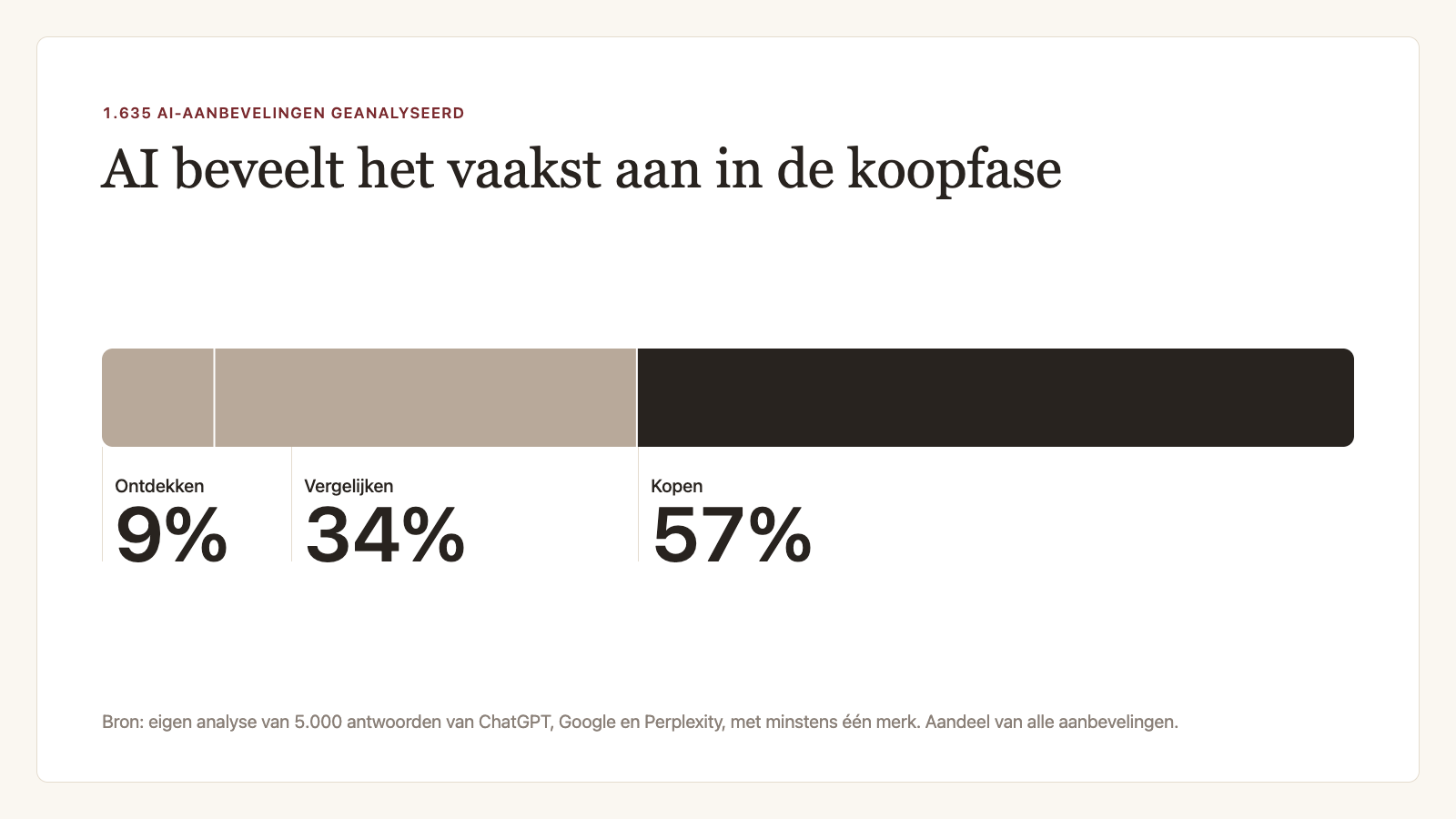
Recommendations appear mostly in buying questions
I found 1,635 positive recommendations in total. Of these, 146 were in the awareness stage, 551 in consideration and 938 in decision. In my question set, positive recommendations appeared most often in the decision stage. Concrete buying questions are more likely to ask for a judgement about a brand.
That makes an average visibility score only partly useful. Also look at the stage in which you are mentioned. Do you appear in broad discovery questions, or only when someone is close to making a choice? Are you visible in comparisons but absent during initial research? These situations call for different pages and different evidence.
Context helps earn a recommendation
Brands described as specialists in the answer appeared surprisingly often as suitable choices. That is not a reason to put the word “specialist” everywhere. Context matters. Are you mentioned as a solution to a specific problem, or are you just one name among familiar providers?
It helps when several sources confirm what you do and whom you work with. Do not just describe your strengths yourself. Use case studies, industry pages, independent articles, interviews and comparisons to show whom you work with, which problem you solve and what the result was. Skip the self-congratulation. Let the evidence do the work.
My articles in Marketingfacts are two examples: From SEO to GEO: Which B2B content performs in ChatGPT, Google AIO and Perplexity? and AI mostly points self-employed professionals to Rabobank.
Citations and technical optimisation
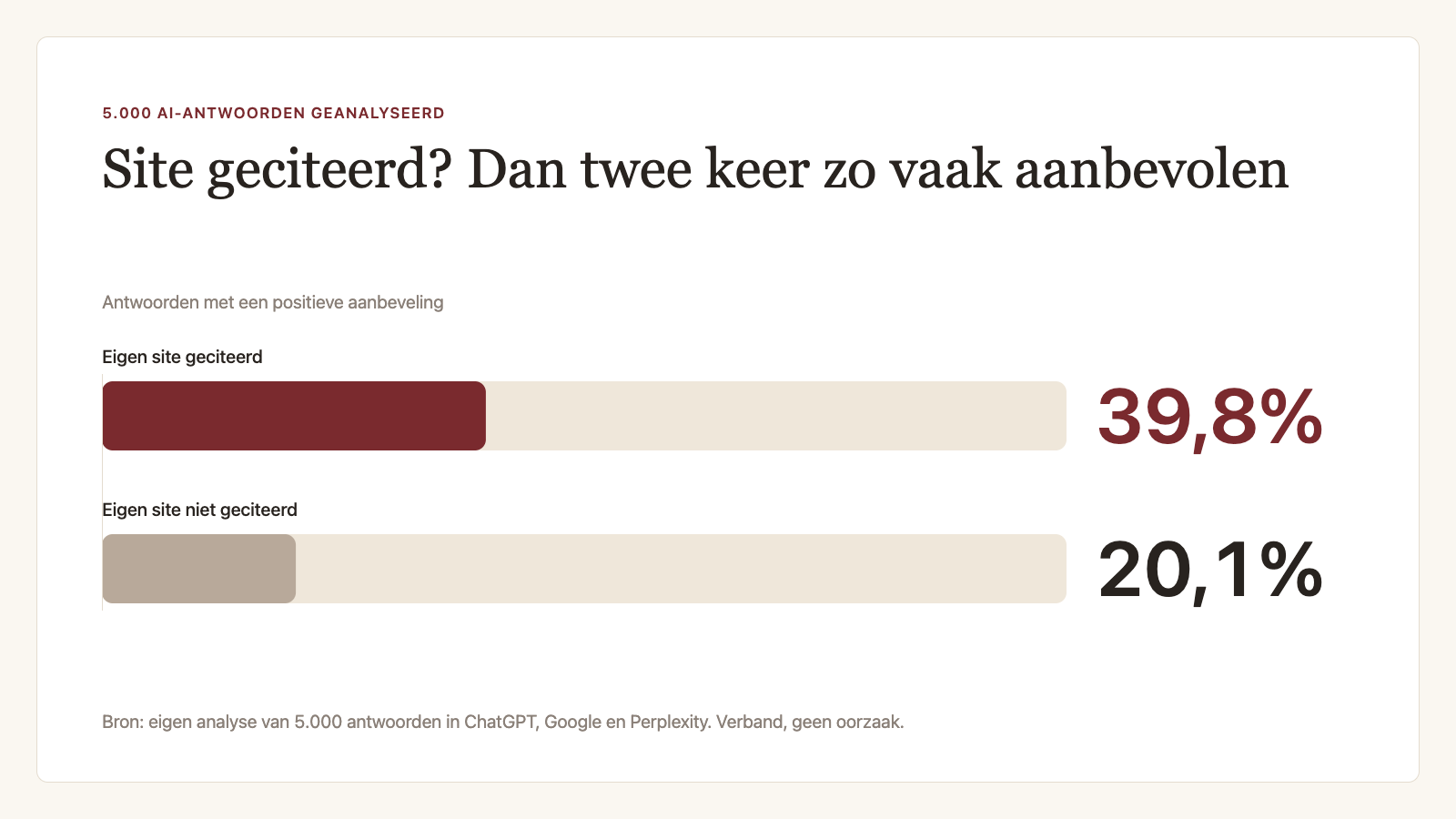
I saw a second pattern in the citations. When a website was cited as a source, an answer also included a recommendation in 39.8% of cases. Without a citation, that figure was 20.1%. In this measurement, recommendations were therefore considerably more common when the brand’s own domain appeared as a source.
That does not mean a technical page optimisation will automatically get you recommended. The measurement only shows an association. Is your site cited because it supports the answer better? Is the page clear about its audience or use case? Or does the content fit the question better? A sound technical GEO foundation helps, but the content still needs to add something.
A step-by-step guide to greater AI visibility
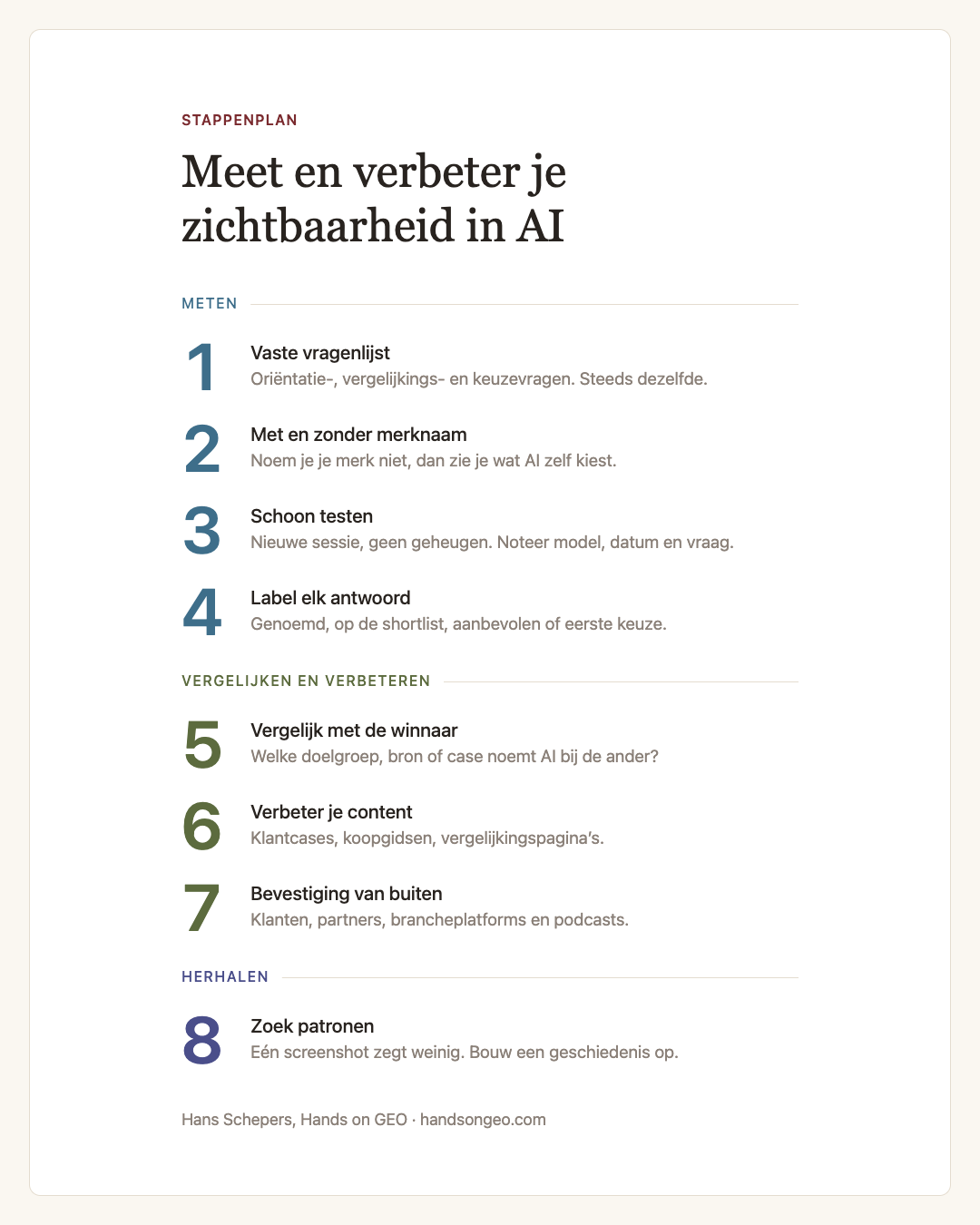
Want to investigate how visible you are in AI and where you can improve? Start with a consistent way to measure it.
- Build a fixed question set. Use broad discovery questions, comparison questions and concrete buying questions.
- Mix branded and unbranded questions. If you include your brand in the question, AI is likely to mention it. It is more revealing to see what happens without your brand name.
- Test under consistent conditions. Start a new session each time, without search history or personal memory. Record the model, date and question.
- Label every brand. For each answer, note whether your brand is mentioned, shortlisted, recommended or named as the first choice.
- Compare against the recommended brand. Do not look only at AI’s explanation after the fact. Compare the answers themselves. Which audience, use case, source, case study or limitation is mentioned for the other provider?
- Improve your content. Explain who your solution suits. Add case studies covering the problem, approach and result. Write comparison pages and let customers speak. Be clear about when someone should choose another provider.
- Seek confirmation beyond your own website. Ask customers, partners, industry platforms, podcasts, interviewers and other independent sources to describe specifically what you do and whom it helps.
- Look for patterns. Answers vary by model, question and timing. One screenshot says little. Repeated patterns are more useful, which means building a history.
What you can learn from this measurement
I had hoped to find one clear answer to when AI recommends one brand but not another. The models remain largely a black box. A correlation would have been even better, but the answer turned out not to be that simple.
The practical conclusion is clear, though: if you want to become more visible in AI, you need to do more than publish more content. Make sure your brand appears at the right moments in the buyer journey, for a clear reason and with evidence that is visible beyond your own website.
A web developer who knows how to make your website accessible to AI is a prerequisite. After that, the content determines whether a page adds value. Getting recommended by AI takes both technology and focused content marketing. You build that through repeated measurements, specific pages and evidence others can verify.
Also read the questions for the awareness stage, the comparison stage and the buying stage.
This translation was made by AI.