
What is AI Search in brief?
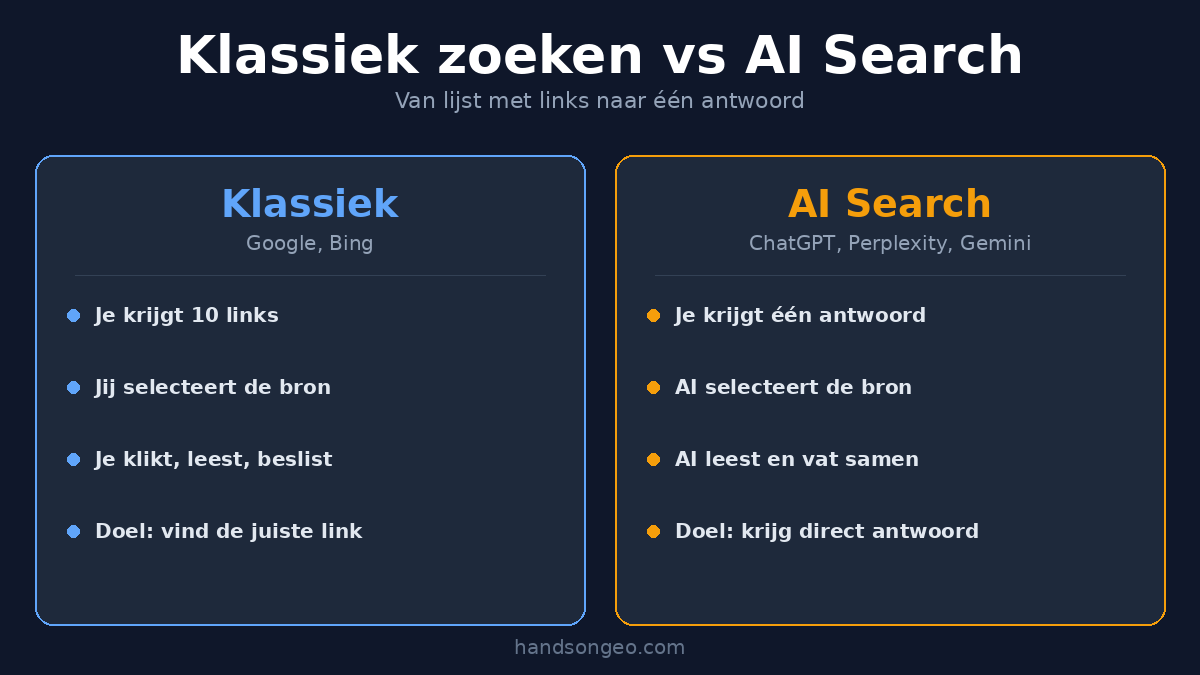
AI search refers to search engines and tools that generate synthesized answers to questions instead of showing a ranked list of links. Instead of ten blue links that you choose from yourself, AI search reads multiple sources and puts together a personal answer in real time, often with references to the sources it used.
The main AI search platforms (2026)
Perplexity. A search engine that provides answers with source citations. Perplexity cites sources in 97% of answers, making it the most transparent AI search platform for measuring content visibility (Otterly.AI, 2025). It combines real-time web search with synthesis by a language model.
ChatGPT with browsing. OpenAI’s ChatGPT can search the web in real time when answering questions. It cites sources in approximately 16% of answers (Otterly.AI, 2025). The lower citation rate is because ChatGPT also relies heavily on pre-trained knowledge.
Google AI Overviews. Google’s integration of AI-generated summaries at the top of the search results page. When AI Overviews are triggered, Google Gemini writes an answer based on multiple sources and shows it above the traditional organic results. Because this integrates seamlessly with Google Search, which has effectively held a monopoly on search for 20 years, using Google AI Overviews requires almost no extra step.
Gemini. Google’s standalone AI assistant, separate from Google Search, which combines language-model capabilities with access to Google Search data. Gemini can search the web and provide answers with source citations, similar to Perplexity.
How AI search selects sources
AI search platforms use retrieval-augmented generation (RAG): they first search the web for relevant content and then use a language model to combine the information they find into a coherent answer. The selection process favors content that:
- Is factually precise. Passages with specific data points, named sources and verifiable claims are retrieved and cited more often.
- Is clearly structured. Content with descriptive headings, direct answers to questions and a logical structure is easier for AI systems to process.
- — (no reliable proposal possible without seeing the source structure) Websites and authors that consistently appear across multiple reliable sources — with schema markup, Wikidata entries and a presence across platforms — are treated as more authoritative.
- Is current. Content with recent publication or update dates carries more weight, especially for topics where information changes quickly.
Reddit is a notable source: large language models cite Reddit 3,212 times compared with 961 citations for Wikipedia (Otterly.AI, 2025). This suggests that authentic, experience-based content from real users matters in AI search. Reddit is not really dominant in the Netherlands yet. I regularly see Dutch subreddits, but when you look at the number of active participants, their numbers pale in comparison with American subreddits. I expect that to change in the coming years, and that Reddit will become more important here as well.
How AI search differs from traditional search
In traditional search, the goal is to rank as high as possible in a list of links. Users click through to your site, and you measure success by looking at how many do so and whether they convert. In AI search, the goal is to be selected as a source in the generated answer. Users may never visit your site directly — they read the AI-generated answer that refers to your content. Success is then measured by how often you are cited, how that happens and whether it generates leads. This shift affects the structure of your content. Traditional SEO rewards extensive, long-form content that keeps users on the page. GEO rewards concise, citable passages that AI models can find in your content in milliseconds.
The impact on B2B marketing
For B2B marketers, AI search changes how customers start their buyer journey. Decision-makers increasingly use AI tools to research solutions, compare suppliers and understand industry concepts. Being cited in an AI-generated answer can influence purchase decisions before a prospect visits your website. That makes entity optimization and LLMO strategic priorities, not just technical SEO tasks.
Frequently asked questions about AI Search
What is the difference between AI Search and traditional search?
Traditional search gives you a list of links — the user chooses which source to open. AI Search generates one summarized answer, sometimes with a limited number of source citations. For B2B marketers, the question shifts from “do I rank highly?” to “am I selected as a source?”
Which AI Search platforms are most relevant for B2B?
At the moment, ChatGPT (with browsing), Perplexity, Google AI Overviews and Gemini are the platforms most often used in a B2B context. Perplexity shows explicit source citations for each answer. Google AI Overviews has the largest potential user base. ChatGPT and Gemini are less transparent about their sources but still influential for exploratory questions.
How do I measure whether my content is cited in AI Search?
Systematically: send the same questions to multiple platforms and record whether and how your brand is mentioned. Automate this with tools such as Quolity or build your own measurement setup. An occasional measurement gives you a snapshot; measuring over time shows trends and the effect of content changes.
Related concepts
- GEO (Generative Engine Optimization) — optimizing content to be cited in AI search results
- LLMO (Large Language Model Optimization) — the broader discipline of optimizing for language models
- Entity Optimization — making brands and people recognizable to AI systems
- Knowledge Graph — structured data that AI uses to understand relationships between entities
Page updated: May 2026 | Written by Hans Schepers, a digital marketing professional specializing in GEO and AI visibility for B2B brands.